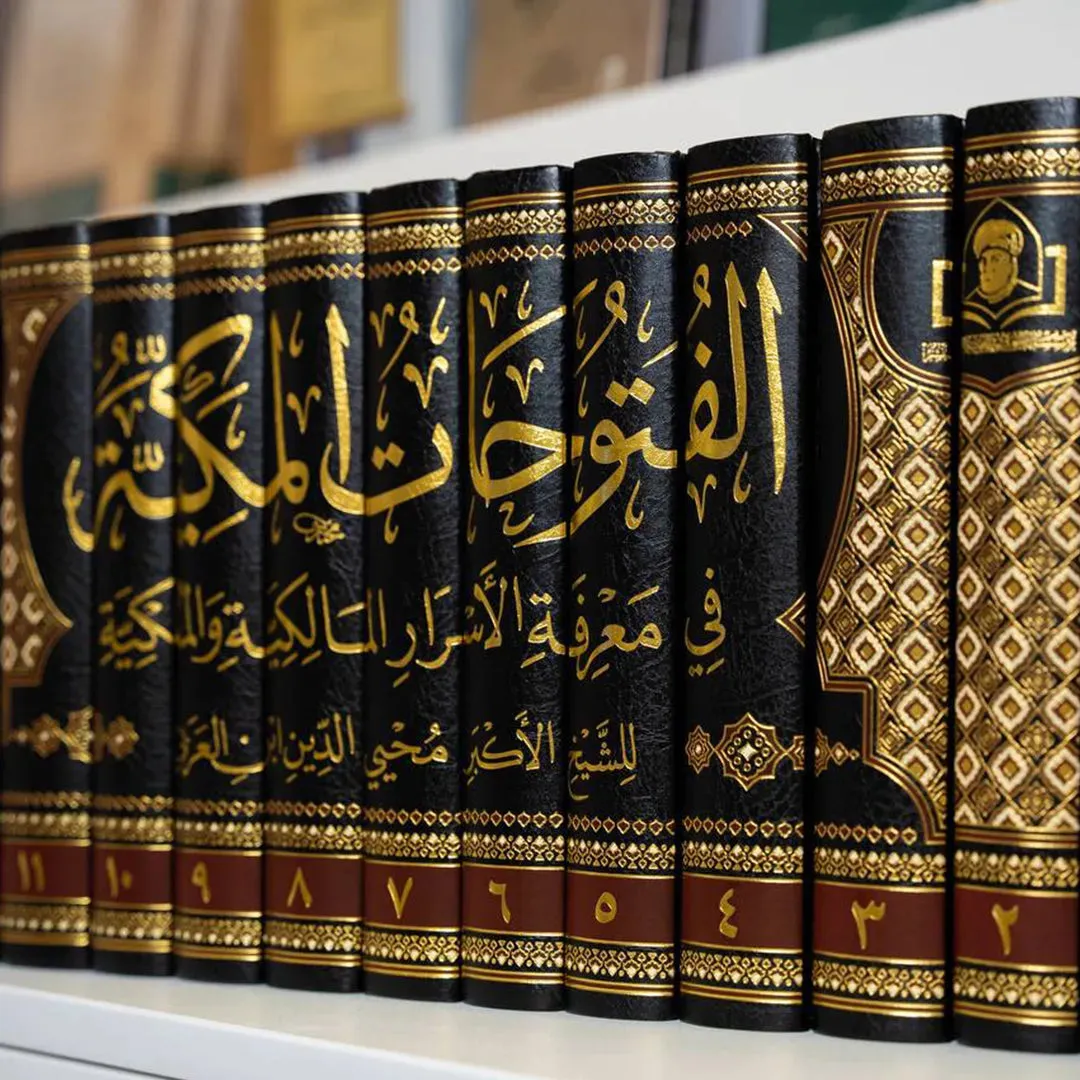


al-Futuhat al-Makkiyya (14 Vols)
About The Book
al-Futuhat al-Makkiyya — the Meccan Openings — is the magnum opus of Shaykh al-Akbar Muhyi al-Din Ibn al-Arabi and the most ambitious single work in the entire literature of Islamic spirituality. Begun in Mecca in 598 AH and completed thirty years later in Damascus, the Futuhat is organised into 560 chapters covering the full sweep of the Akbari school's metaphysics: the science of the divine Names and Attributes, the levels of being (maratib al-wujud), the realities of prophecy and sainthood, the cosmology of the world's hidden orders, the inner meanings of ritual practice, and the ascending stations and states of the spiritual wayfarer. Ibn al-Arabi describes the work as having been received through divine opening (futuh) during his presence at the Sacred House — from which the title.
This 14-volume critical edition runs to approximately 9,964 pages with a full scholarly apparatus. The Foundation's edition is recognised among specialists for its textual care and for restoring readings consistent with the most reliable manuscript witnesses, including the Bayazid manuscripts copied from the First Recension — a dimension of editorial method set out in full in the description below.
About The Author
Shaykh al-Akbar Muhyi al-Din Muhammad b. Ali Ibn al-Arabi (560–638 AH / 1165–1240 CE) was an Andalusian Sufi master whose vast literary output — over 250 works survive — reshaped the language of Islamic metaphysics. Born in Murcia, he travelled extensively through al-Andalus, North Africa, the Mashriq, and Anatolia, settling in Damascus in his later years, where his tomb remains a place of visitation. Beyond the Futuhat, his Fusus al-Hikam is the other classical anchor of the Akbari school.
About This Edition
Praise be to God, and may blessings and peace be upon our master Muhammad and his family.
Al-Futuhat al-Makkiyya of Shaykh al-Akbar Muhyi al-Din Ibn al-Arabi stands as the most celebrated encyclopaedia of Islamic spirituality ever composed. The Shaykh began writing it in the year 599 AH during his first residence in Mecca, in the proximity of the Sacred House and its Noble Ka'ba; he completed it in Damascus in 629 AH. The popular story that he spent an entire year composing the work atop the Ka'ba, and that the manuscript emerged from that vigil undamaged, has no foundation whatsoever — it belongs to the kind of popular exaggeration that circulates on the tongues of the uninformed. The work stands in no need of such embellishment; the sciences, insights, and spiritual refinements it contains are sufficient to establish its inestimable value.
Those who concern themselves with Sufism in general, and with Ibn al-Arabi in particular, will be familiar with the well-attested account that he produced a second redaction of the Futuhat, intending to present it as a gift to his foster son and foremost student, the great Shaykh Sadr al-Din al-Qunawi. He began work on this copy in 632 AH and completed it in 636 AH — two years before his death. This is the copy known as the Quniyya Manuscript, upon which all printed editions of the work have been based, with the sole exception of the first.
The Printed Editions
The first edition of al-Futuhat al-Makkiyya — known as the Bulaq Edition — appeared in 1858 CE at the order of Khedive Abbas I of Egypt, who passed away before the printing was complete; his successor, Khedive Muhammad Sa'id Pasha, carried the project through to completion. This edition was based on a manuscript preserved in the Süleymaniye Library in Istanbul, transcribed from the First Recension, which the Shaykh al-Akbar completed in 629 AH.
When the Mujahid Prince Abd al-Qadir al-Jaza'iri examined the Bulaq Edition and had knowledge of the Quniyya Manuscript, he recognised the necessity of collating the printed text against the Quniyya copy — which, as the date of its completion shows, represents the version the Shaykh ratified in the final two years of his life. He entrusted this task to two eminent scholars: Shaykh Muhammad b. Mustafa al-Tantawi al-Misri and Shaykh al-Tayyib b. Muhammad al-Mubarak al-Jaza'iri, who travelled at his expense and recorded the results of the collation in the margins of the printed edition — this was in 1287 AH. A second edition appeared in 1910 / 1329 AH, corrected on the basis of the Prince's annotated copy, which had itself been verified against the Quniyya Manuscript. All subsequent reprintings of the work relied upon this second edition.
These editions, for all their importance, are not properly critical editions in the scholarly sense. The Syrian researcher Dr. Uthman Yahya therefore began a critical edition commissioned by the Sorbonne in 1954, though he did not complete the entire work: fourteen volumes were published by the Egyptian General Book Authority in collaboration with the Sorbonne and UNESCO, covering through Chapter 161 of 560 — the chapter on the Station of Nearness — and appeared serially between 1972 and 1992. This was followed by the Yemen Edition of 2010, critically edited by Dr. Abd al-Aziz Sultan al-Mansub and subsequently reprinted in Cairo by the Supreme Council for Culture — the finest edition of this great work to appear in print, in 13 volumes, relying primarily on the Quniyya Manuscript.
The Present Editor's Work
The present editor began work on this text during his tenure as Managing Editor of the Heritage Series at the Egyptian General Book Authority, originally intending to complete Dr. Uthman Yahya's unfinished edition. That intention was not fulfilled at the time, yet he remained devoted to serving this book. Whenever he encountered a passage that gave him pause, he would suppose it a printing error — until he obtained a photographic copy of the Quniyya Manuscript and began consulting it against doubtful passages. He found that a great deal of what he had noted was not an error of the critical editor, but was present as such in the Quniyya Manuscript itself — including errors too fundamental to be attributed to the author, and cases where the copyist evidently did not understand Ibn al-Arabi at all.
Despite the effort invested by all those who have served this book, their conviction that the Quniyya Manuscript was in the Shaykh al-Akbar's own hand led them to favour it above all others — and perhaps none of them took care to acquaint the reader with what precisely distinguishes the Quniyya copy as the Final Recension of the work. Its colophon reads:
"The completion of this chapter occurred on the morning of Wednesday the twenty-fourth of Rabi' al-Awwal, in the year 636 AH. Written in his own hand by its composer, Muhammad b. Ali b. Muhammad b. al-Arabi al-Ta'i al-Hatimi — may God grant him success. This copy comprises thirty-seven volumes and contains additions beyond the First Recension, which I endowed to my son Muhammad al-Kabir — and to his descendants, and to the Muslims thereafter, east and west, by land and by sea."
This moved the present editor, as a devoted reader of the Shaykh al-Akbar, to determine what he described as additions — material incorporated into the Quniyya copy but absent from the First Recension — alongside the doubts he had already formed regarding whether the Quniyya Manuscript truly is in the Shaykh's own hand, given the errors he had identified in it. These considerations prompted him to undertake a critical edition by examining representative specimens from both recensions. Confirmation was found: in Chapter Seventy-Two (Quniyya: Vol. 10, f. 148a) the Shaykh himself refers to the First Recension — "we have set it out fully in the First Recension of this book" — and consulting the Bayazid Manuscript (Vol. 3743, f. 377b), the passage is indeed found treated there in full.
The Manuscripts of the Two Recensions
The ravages of time have prevented any complete manuscript of the First Recension from reaching us. The surviving copies either combine elements of both recensions — with certain passages copied from First Recension witnesses and others from Second Recension witnesses — or they represent a further composite type that selects between variant readings and produces a text that is neither the one nor the other. It appears that copyists received manuscripts representing both recensions and transcribed from them interchangeably, without distinguishing between the two.
The principal First Recension witnesses are the Bayazid Manuscripts, nos. 3743–3746, copied in 683 AH from an exemplar written in the author's own hand in 629 AH — most likely either the First Recension copy the Shaykh wrote and presented to his son Sa'd al-Din, or a copy derived from it. They are written in a clear, well-vocalised hand, with the exception of certain portions written in a later hand dated 1212 AH. The Bayazid set nos. 3747–3749 are copies of the preceding, but corrupt in transcription and therefore excluded.
The principal Second Recension witnesses include the Hakim Oghlu, Damad Ibrahim Pasha, and Nur Uthmaniyya manuscripts — texts that alternate between both recensions and sometimes conflate them. Among the most important of these is Nur Uthmaniyya no. 2501, written by Ibn al-Kamal, a student of the illustrious 'Abd al-Ghani al-Nabulsi, under his teacher's direct supervision and with his authorisation to transmit the Futuhat from beginning to end. Chief among all Second Recension witnesses is the Quniyya Manuscript, nos. 1736–1772, from which most other Second Recension copies derive.
Is the Quniyya Manuscript in the Shaykh al-Akbar's Own Hand?
The attribution of the Quniyya Manuscript to Ibn al-Arabi's autograph is celebrated in Sufi studies and was affirmed by the ancients — among them 'Abd al-Wahhab al-Sha'rani (d. 973 AH). The evidence adduced consists of: the Shaykh's signature at the opening of the first volume; a note in his hand at the fifth volume; audition notices (Vol. 1, f. 47a; Vol. 32, f. 126b); authorisations on the author (Vol. 6, f. 160b); and collation notes against the First Recension by Sadr al-Din al-Qunawi and Ibn Sawdakin (Vol. 14, f. 157b). However, these items do not constitute the kind of rigorous evidence that would raise the attribution even to the level of strong probability — much less establish it as a certainty — since the possibility remains that the signature and other marks were faithfully reproduced from the autograph exemplar by the copyist. When a plausible alternative explanation is available, the argument loses its force. The numerous errors found in the Quniyya Manuscript in the course of collation further complicate the attribution.
Specimens of Errors in the Quniyya Manuscript
By way of illustration: in Chapter Two (Vol. 1, f. 95a) the Quniyya reads "eighty-eight celestial spheres" where arithmetic requires thirty-eight, as confirmed by Bayazid. In Chapter Sixty-Nine on the Mysteries of Prayer (Vol. 7, f. 41a), "before the standing at Arafat" appears in Quniyya where the context — and Bayazid — require "after." In Chapter Seventy-Two (Vol. 10, f. 109b), the Quniyya reads "the shortening of the prayer" (qasr) where context and Bayazid both require "the completion of the prayer" (itmam). Among lacunae: the Quniyya omits from Chapter Three the clause "and simples are uncompounded; as for kayfa?, it is an inquiry concerning composites" — rendering the subsequent argument incomplete. Multiple additional errors of arithmetic, letter identification, scribal misreading, and substantive omission are documented in the critical apparatus of this edition.
The Relationship Between the Two Recensions
A reader who examines the Bayazid Manuscript alongside the Quniyya will discern a clear divergence between the two in their rendering of the text. But does this divergence constitute a fundamental disjunction — one that would allow us to say that Ibn al-Arabi departed from the substance of the First Recension in the Second? On the basis of this edition's examination, the answer is no: the divergence is, in the main, a divergence in manner of expression, not in substance — the ideas and positions are the same, but the mode of rendering them differs, with passages of agreement between the recensions far outnumbering passages of divergence. The most immediately striking difference is that the Bayazid exhibits robust, eloquent, economical prose, while the Quniyya favours expressions more accessible to the general reader, with a somewhat more expansive and explanatory treatment of the meaning.
The differences between the two recensions fall into three categories: (1) Additions in the Quniyya not present in Bayazid — ranging from a few words to entire sections, including notably the 'Aqida al-Nashi'a al-Shadiyya and the 'Aqida al-Khawass, which together occupy Vol. 1, ff. 64a–84b in the Quniyya but are entirely absent from the Bayazid, even though the discourse flows unbroken without them. The jurisprudential chapters (on purification, prayer, zakat, fasting, and pilgrimage) also contain numerous additions and explicit statements of the Shaykh al-Akbar's jurisprudential preferences with their reasonings. (2) Expository and supplementary passages intended to complete thoughts that remained unfinished in the Bayazid, or to expand and clarify the obscure.
عن الكتاب
"الفتوحات المكية" أعظم مؤلَّفات الشيخ الأكبر محيي الدين ابن العربي، وأشمل عمل في تاريخ التصوّف الإسلامي. ابتدأ تأليفه بمكّة سنة ٥٩٨ هـ، وأتمّه بدمشق بعد ثلاثين سنة، ووَزَع موضوعاته في ٥٦٠ باباً تستوعب كامل مذهب المدرسة الأكبريّة: علم الأسماء والصفات، ومراتب الوجود، وحقائق النبوّة والولاية، وعلم الأكوان الباطنية، والمعاني الباطنة للعبادات، ومنازل السالكين ومقاماتهم. صدرت هذه الطبعة المحقّقة في أربعة عشر مجلداً (نحو ٩٩٦٤ صفحة)، اعتمدت على أوثق النسخ الخطّيّة، ومنها نسخة بايزيد الممثِّلة للإبرازة الأولى.
عن المؤلف
الشيخ الأكبر محيي الدين محمد بن علي ابن العربي (٥٦٠-٦٣٨ هـ)، صوفيٌّ أندلسيٌّ من أعظم مؤرّخي الفكر الميتافيزيقي في الإسلام، له أكثر من ٢٥٠ مؤلَّفاً. ولد بمرسية، وارتحل في الأندلس والمغرب والمشرق والأناضول، واستقرّ في آخر حياته بدمشق، وقبره فيها يُزار. وكتابه "فصوص الحكم" هو ركيزته الكلاسيكية الأخرى بعد الفتوحات.
وصف الطبعة
الحمد لله، والصلاة والسلام على سيدنا محمدٍ وآله.
أما بعد: فإنَّ كتابَ الشيخِ الأكبرِ محيي الدين ابن العربي، المُسَمَّى «الفتوحات المكِّيَّة»، يُعد موسوعة التصوف الأشهر، شَرَع رضي الله عنه في كتابته سنة (599هـ)، في مكة المكرمة في بداية مجاورته لبيت الله الحرام؛ وكعبته المُشَرَّفَة، وانتهى من تصنيفه سنة (629هـ)، في دمشق، وعلى هذا فإنَّ ما يُحكى حولَ أنَّه وضعه عامًا كاملًا فوق سطح الكعبة، وأن الكتاب لم يَحْصُل به أيُّ تلفٍ، واعتبار ذلك مما يُعطي هذا الكتاب قيمة إضافية، كلُّ هذا لا أصل له، وإنَّما هو مِمَّا يَجري على ألسنة العوام من المُبَالغات، فإنَّ ما تضمَّنَهُ الكتاب من العلومِ والمعارف والآداب لا يَحتاج إلى غيرِه لإبراز قيمته العلمية.
ولا يخفى على المهتمين بالتصوف عامَّةً، وبابن العربي خاصَّةً، ما اشتهر من أنه رضي الله عنه قد كَتَبَ نسخةً ثانيةً من فتوحاته المكية، بغرض إهدائها لرَبيبه الشيخ الكبير صدر الدين القُونَوِيِّ، وأنه بدأ تقييد هذه النسخة سنة (632هـ)، وأتمَّها سنة (636هـ)، تلك النسخة المعروفة بنسخة قونية، والتي اعتمدتْ عليها كلُّ مطبوعات هذا الكتاب فيما عدا طبعته الأولى.
وكانت أولُ طبعات الفتوحات المكية، والمعروفة بطبعة بُولاق، قد صدرت سنة (1858م)، بأمر الخديوي عباس الأول حاكم مصر، والذي توفاه الله تعالى قبل الانتهاء من طباعة الكتاب، فاعتنى به خليفته الخديوي محمد سعيد باشا، وقد اعتمدتْ تلك الطبعة على نسخة مخطوطة محفوظة في المكتبة السليمانية بإسطنبول، وهي منقولة من نسخة الإبرازة الأولى للكتاب.
ثم إنَّ الأمير المجاهد عبد القادر الجزائري رأى ضرورة مطابقة طبعة بولاق بنسخة قونية، فكلَّف بهذه المهمة الشيخ محمد بن مصطفى الطنطاوي والشيخ الطيب بن محمد المبارك الجزائري، فسافرا على نفقته وأثبتا نتائج المطابقة على هامش النسخة المطبوعة سنة 1287هـ. وصدرت للفتوحات طبعة ثانية سنة 1910م اعتمدت على نسخة الأمير المراجَعة، وعليها اعتمدت جميع الطبعات اللاحقة.
وشرع الباحث الدكتور عثمان يحيى في تحقيق الفتوحات سنة 1954م بتكليف من جامعة السوربون، غير أنه لم ينته من تحقيقه كاملًا، إذ توقفت الطبعة عند الباب (161) من أصل 560 باباً، وصدرت بالتوالي ما بين 1972م و1992م. ثم جاءت طبعة اليمن سنة 2010م بتحقيق الدكتور عبد العزيز سلطان المنصوب في 13 مجلداً، وهي بلا شكٍّ أفضل مطبوعات هذا الكتاب الجليل.
وقد شرع المحقق الحالي في تحقيق هذا الكتاب أثناء عمله مديرًا لتحرير سلسلة التراث بالهيئة المصرية العامة للكتاب، وكان غرضه استكمالَ عمل الدكتور عثمان يحيى. وبعد تحصُّله على صورة ضوئية من نسخة قونية، وجد أن كثيرًا مما استشكله لم يكن سهوًا من المحقق، بل هو موجود في نسخة قونية ذاتها — بما في ذلك أخطاء يستحيل صدورها عن المؤلف، وحالات يتبيَّن فيها أن الناسخ لا يفهم ابن العربي أصلًا. وقد دفعه ذلك إلى الوقوف على نماذج من الإبرازتين، فتبيَّن له أن نسخة قونية تنفرد بالإشارة إلى وجود نسخة أولى للفتوحات في قوله: «بسطناه في النسخة الأولى من هذا الكتاب»، وبالرجوع إلى نسخة بايزيد وُجد هذا الموضع قد تم بسطه كما أشار إليه الشيخ.
وتفصيل ذلك وبيان نسخ الإبرازتين، ونماذج الأخطاء والسقط والتحريف في نسخة قونية، والفروق بين الإبرازتين — كل ذلك مبسوط في مقدمة التحقيق.
Original: $799.99
-65%$799.99
$280.00Product Information
Product Information
Shipping & Returns
Shipping & Returns
Description
About The Book
al-Futuhat al-Makkiyya — the Meccan Openings — is the magnum opus of Shaykh al-Akbar Muhyi al-Din Ibn al-Arabi and the most ambitious single work in the entire literature of Islamic spirituality. Begun in Mecca in 598 AH and completed thirty years later in Damascus, the Futuhat is organised into 560 chapters covering the full sweep of the Akbari school's metaphysics: the science of the divine Names and Attributes, the levels of being (maratib al-wujud), the realities of prophecy and sainthood, the cosmology of the world's hidden orders, the inner meanings of ritual practice, and the ascending stations and states of the spiritual wayfarer. Ibn al-Arabi describes the work as having been received through divine opening (futuh) during his presence at the Sacred House — from which the title.
This 14-volume critical edition runs to approximately 9,964 pages with a full scholarly apparatus. The Foundation's edition is recognised among specialists for its textual care and for restoring readings consistent with the most reliable manuscript witnesses, including the Bayazid manuscripts copied from the First Recension — a dimension of editorial method set out in full in the description below.
About The Author
Shaykh al-Akbar Muhyi al-Din Muhammad b. Ali Ibn al-Arabi (560–638 AH / 1165–1240 CE) was an Andalusian Sufi master whose vast literary output — over 250 works survive — reshaped the language of Islamic metaphysics. Born in Murcia, he travelled extensively through al-Andalus, North Africa, the Mashriq, and Anatolia, settling in Damascus in his later years, where his tomb remains a place of visitation. Beyond the Futuhat, his Fusus al-Hikam is the other classical anchor of the Akbari school.
About This Edition
Praise be to God, and may blessings and peace be upon our master Muhammad and his family.
Al-Futuhat al-Makkiyya of Shaykh al-Akbar Muhyi al-Din Ibn al-Arabi stands as the most celebrated encyclopaedia of Islamic spirituality ever composed. The Shaykh began writing it in the year 599 AH during his first residence in Mecca, in the proximity of the Sacred House and its Noble Ka'ba; he completed it in Damascus in 629 AH. The popular story that he spent an entire year composing the work atop the Ka'ba, and that the manuscript emerged from that vigil undamaged, has no foundation whatsoever — it belongs to the kind of popular exaggeration that circulates on the tongues of the uninformed. The work stands in no need of such embellishment; the sciences, insights, and spiritual refinements it contains are sufficient to establish its inestimable value.
Those who concern themselves with Sufism in general, and with Ibn al-Arabi in particular, will be familiar with the well-attested account that he produced a second redaction of the Futuhat, intending to present it as a gift to his foster son and foremost student, the great Shaykh Sadr al-Din al-Qunawi. He began work on this copy in 632 AH and completed it in 636 AH — two years before his death. This is the copy known as the Quniyya Manuscript, upon which all printed editions of the work have been based, with the sole exception of the first.
The Printed Editions
The first edition of al-Futuhat al-Makkiyya — known as the Bulaq Edition — appeared in 1858 CE at the order of Khedive Abbas I of Egypt, who passed away before the printing was complete; his successor, Khedive Muhammad Sa'id Pasha, carried the project through to completion. This edition was based on a manuscript preserved in the Süleymaniye Library in Istanbul, transcribed from the First Recension, which the Shaykh al-Akbar completed in 629 AH.
When the Mujahid Prince Abd al-Qadir al-Jaza'iri examined the Bulaq Edition and had knowledge of the Quniyya Manuscript, he recognised the necessity of collating the printed text against the Quniyya copy — which, as the date of its completion shows, represents the version the Shaykh ratified in the final two years of his life. He entrusted this task to two eminent scholars: Shaykh Muhammad b. Mustafa al-Tantawi al-Misri and Shaykh al-Tayyib b. Muhammad al-Mubarak al-Jaza'iri, who travelled at his expense and recorded the results of the collation in the margins of the printed edition — this was in 1287 AH. A second edition appeared in 1910 / 1329 AH, corrected on the basis of the Prince's annotated copy, which had itself been verified against the Quniyya Manuscript. All subsequent reprintings of the work relied upon this second edition.
These editions, for all their importance, are not properly critical editions in the scholarly sense. The Syrian researcher Dr. Uthman Yahya therefore began a critical edition commissioned by the Sorbonne in 1954, though he did not complete the entire work: fourteen volumes were published by the Egyptian General Book Authority in collaboration with the Sorbonne and UNESCO, covering through Chapter 161 of 560 — the chapter on the Station of Nearness — and appeared serially between 1972 and 1992. This was followed by the Yemen Edition of 2010, critically edited by Dr. Abd al-Aziz Sultan al-Mansub and subsequently reprinted in Cairo by the Supreme Council for Culture — the finest edition of this great work to appear in print, in 13 volumes, relying primarily on the Quniyya Manuscript.
The Present Editor's Work
The present editor began work on this text during his tenure as Managing Editor of the Heritage Series at the Egyptian General Book Authority, originally intending to complete Dr. Uthman Yahya's unfinished edition. That intention was not fulfilled at the time, yet he remained devoted to serving this book. Whenever he encountered a passage that gave him pause, he would suppose it a printing error — until he obtained a photographic copy of the Quniyya Manuscript and began consulting it against doubtful passages. He found that a great deal of what he had noted was not an error of the critical editor, but was present as such in the Quniyya Manuscript itself — including errors too fundamental to be attributed to the author, and cases where the copyist evidently did not understand Ibn al-Arabi at all.
Despite the effort invested by all those who have served this book, their conviction that the Quniyya Manuscript was in the Shaykh al-Akbar's own hand led them to favour it above all others — and perhaps none of them took care to acquaint the reader with what precisely distinguishes the Quniyya copy as the Final Recension of the work. Its colophon reads:
"The completion of this chapter occurred on the morning of Wednesday the twenty-fourth of Rabi' al-Awwal, in the year 636 AH. Written in his own hand by its composer, Muhammad b. Ali b. Muhammad b. al-Arabi al-Ta'i al-Hatimi — may God grant him success. This copy comprises thirty-seven volumes and contains additions beyond the First Recension, which I endowed to my son Muhammad al-Kabir — and to his descendants, and to the Muslims thereafter, east and west, by land and by sea."
This moved the present editor, as a devoted reader of the Shaykh al-Akbar, to determine what he described as additions — material incorporated into the Quniyya copy but absent from the First Recension — alongside the doubts he had already formed regarding whether the Quniyya Manuscript truly is in the Shaykh's own hand, given the errors he had identified in it. These considerations prompted him to undertake a critical edition by examining representative specimens from both recensions. Confirmation was found: in Chapter Seventy-Two (Quniyya: Vol. 10, f. 148a) the Shaykh himself refers to the First Recension — "we have set it out fully in the First Recension of this book" — and consulting the Bayazid Manuscript (Vol. 3743, f. 377b), the passage is indeed found treated there in full.
The Manuscripts of the Two Recensions
The ravages of time have prevented any complete manuscript of the First Recension from reaching us. The surviving copies either combine elements of both recensions — with certain passages copied from First Recension witnesses and others from Second Recension witnesses — or they represent a further composite type that selects between variant readings and produces a text that is neither the one nor the other. It appears that copyists received manuscripts representing both recensions and transcribed from them interchangeably, without distinguishing between the two.
The principal First Recension witnesses are the Bayazid Manuscripts, nos. 3743–3746, copied in 683 AH from an exemplar written in the author's own hand in 629 AH — most likely either the First Recension copy the Shaykh wrote and presented to his son Sa'd al-Din, or a copy derived from it. They are written in a clear, well-vocalised hand, with the exception of certain portions written in a later hand dated 1212 AH. The Bayazid set nos. 3747–3749 are copies of the preceding, but corrupt in transcription and therefore excluded.
The principal Second Recension witnesses include the Hakim Oghlu, Damad Ibrahim Pasha, and Nur Uthmaniyya manuscripts — texts that alternate between both recensions and sometimes conflate them. Among the most important of these is Nur Uthmaniyya no. 2501, written by Ibn al-Kamal, a student of the illustrious 'Abd al-Ghani al-Nabulsi, under his teacher's direct supervision and with his authorisation to transmit the Futuhat from beginning to end. Chief among all Second Recension witnesses is the Quniyya Manuscript, nos. 1736–1772, from which most other Second Recension copies derive.
Is the Quniyya Manuscript in the Shaykh al-Akbar's Own Hand?
The attribution of the Quniyya Manuscript to Ibn al-Arabi's autograph is celebrated in Sufi studies and was affirmed by the ancients — among them 'Abd al-Wahhab al-Sha'rani (d. 973 AH). The evidence adduced consists of: the Shaykh's signature at the opening of the first volume; a note in his hand at the fifth volume; audition notices (Vol. 1, f. 47a; Vol. 32, f. 126b); authorisations on the author (Vol. 6, f. 160b); and collation notes against the First Recension by Sadr al-Din al-Qunawi and Ibn Sawdakin (Vol. 14, f. 157b). However, these items do not constitute the kind of rigorous evidence that would raise the attribution even to the level of strong probability — much less establish it as a certainty — since the possibility remains that the signature and other marks were faithfully reproduced from the autograph exemplar by the copyist. When a plausible alternative explanation is available, the argument loses its force. The numerous errors found in the Quniyya Manuscript in the course of collation further complicate the attribution.
Specimens of Errors in the Quniyya Manuscript
By way of illustration: in Chapter Two (Vol. 1, f. 95a) the Quniyya reads "eighty-eight celestial spheres" where arithmetic requires thirty-eight, as confirmed by Bayazid. In Chapter Sixty-Nine on the Mysteries of Prayer (Vol. 7, f. 41a), "before the standing at Arafat" appears in Quniyya where the context — and Bayazid — require "after." In Chapter Seventy-Two (Vol. 10, f. 109b), the Quniyya reads "the shortening of the prayer" (qasr) where context and Bayazid both require "the completion of the prayer" (itmam). Among lacunae: the Quniyya omits from Chapter Three the clause "and simples are uncompounded; as for kayfa?, it is an inquiry concerning composites" — rendering the subsequent argument incomplete. Multiple additional errors of arithmetic, letter identification, scribal misreading, and substantive omission are documented in the critical apparatus of this edition.
The Relationship Between the Two Recensions
A reader who examines the Bayazid Manuscript alongside the Quniyya will discern a clear divergence between the two in their rendering of the text. But does this divergence constitute a fundamental disjunction — one that would allow us to say that Ibn al-Arabi departed from the substance of the First Recension in the Second? On the basis of this edition's examination, the answer is no: the divergence is, in the main, a divergence in manner of expression, not in substance — the ideas and positions are the same, but the mode of rendering them differs, with passages of agreement between the recensions far outnumbering passages of divergence. The most immediately striking difference is that the Bayazid exhibits robust, eloquent, economical prose, while the Quniyya favours expressions more accessible to the general reader, with a somewhat more expansive and explanatory treatment of the meaning.
The differences between the two recensions fall into three categories: (1) Additions in the Quniyya not present in Bayazid — ranging from a few words to entire sections, including notably the 'Aqida al-Nashi'a al-Shadiyya and the 'Aqida al-Khawass, which together occupy Vol. 1, ff. 64a–84b in the Quniyya but are entirely absent from the Bayazid, even though the discourse flows unbroken without them. The jurisprudential chapters (on purification, prayer, zakat, fasting, and pilgrimage) also contain numerous additions and explicit statements of the Shaykh al-Akbar's jurisprudential preferences with their reasonings. (2) Expository and supplementary passages intended to complete thoughts that remained unfinished in the Bayazid, or to expand and clarify the obscure.
عن الكتاب
"الفتوحات المكية" أعظم مؤلَّفات الشيخ الأكبر محيي الدين ابن العربي، وأشمل عمل في تاريخ التصوّف الإسلامي. ابتدأ تأليفه بمكّة سنة ٥٩٨ هـ، وأتمّه بدمشق بعد ثلاثين سنة، ووَزَع موضوعاته في ٥٦٠ باباً تستوعب كامل مذهب المدرسة الأكبريّة: علم الأسماء والصفات، ومراتب الوجود، وحقائق النبوّة والولاية، وعلم الأكوان الباطنية، والمعاني الباطنة للعبادات، ومنازل السالكين ومقاماتهم. صدرت هذه الطبعة المحقّقة في أربعة عشر مجلداً (نحو ٩٩٦٤ صفحة)، اعتمدت على أوثق النسخ الخطّيّة، ومنها نسخة بايزيد الممثِّلة للإبرازة الأولى.
عن المؤلف
الشيخ الأكبر محيي الدين محمد بن علي ابن العربي (٥٦٠-٦٣٨ هـ)، صوفيٌّ أندلسيٌّ من أعظم مؤرّخي الفكر الميتافيزيقي في الإسلام، له أكثر من ٢٥٠ مؤلَّفاً. ولد بمرسية، وارتحل في الأندلس والمغرب والمشرق والأناضول، واستقرّ في آخر حياته بدمشق، وقبره فيها يُزار. وكتابه "فصوص الحكم" هو ركيزته الكلاسيكية الأخرى بعد الفتوحات.
وصف الطبعة
الحمد لله، والصلاة والسلام على سيدنا محمدٍ وآله.
أما بعد: فإنَّ كتابَ الشيخِ الأكبرِ محيي الدين ابن العربي، المُسَمَّى «الفتوحات المكِّيَّة»، يُعد موسوعة التصوف الأشهر، شَرَع رضي الله عنه في كتابته سنة (599هـ)، في مكة المكرمة في بداية مجاورته لبيت الله الحرام؛ وكعبته المُشَرَّفَة، وانتهى من تصنيفه سنة (629هـ)، في دمشق، وعلى هذا فإنَّ ما يُحكى حولَ أنَّه وضعه عامًا كاملًا فوق سطح الكعبة، وأن الكتاب لم يَحْصُل به أيُّ تلفٍ، واعتبار ذلك مما يُعطي هذا الكتاب قيمة إضافية، كلُّ هذا لا أصل له، وإنَّما هو مِمَّا يَجري على ألسنة العوام من المُبَالغات، فإنَّ ما تضمَّنَهُ الكتاب من العلومِ والمعارف والآداب لا يَحتاج إلى غيرِه لإبراز قيمته العلمية.
ولا يخفى على المهتمين بالتصوف عامَّةً، وبابن العربي خاصَّةً، ما اشتهر من أنه رضي الله عنه قد كَتَبَ نسخةً ثانيةً من فتوحاته المكية، بغرض إهدائها لرَبيبه الشيخ الكبير صدر الدين القُونَوِيِّ، وأنه بدأ تقييد هذه النسخة سنة (632هـ)، وأتمَّها سنة (636هـ)، تلك النسخة المعروفة بنسخة قونية، والتي اعتمدتْ عليها كلُّ مطبوعات هذا الكتاب فيما عدا طبعته الأولى.
وكانت أولُ طبعات الفتوحات المكية، والمعروفة بطبعة بُولاق، قد صدرت سنة (1858م)، بأمر الخديوي عباس الأول حاكم مصر، والذي توفاه الله تعالى قبل الانتهاء من طباعة الكتاب، فاعتنى به خليفته الخديوي محمد سعيد باشا، وقد اعتمدتْ تلك الطبعة على نسخة مخطوطة محفوظة في المكتبة السليمانية بإسطنبول، وهي منقولة من نسخة الإبرازة الأولى للكتاب.
ثم إنَّ الأمير المجاهد عبد القادر الجزائري رأى ضرورة مطابقة طبعة بولاق بنسخة قونية، فكلَّف بهذه المهمة الشيخ محمد بن مصطفى الطنطاوي والشيخ الطيب بن محمد المبارك الجزائري، فسافرا على نفقته وأثبتا نتائج المطابقة على هامش النسخة المطبوعة سنة 1287هـ. وصدرت للفتوحات طبعة ثانية سنة 1910م اعتمدت على نسخة الأمير المراجَعة، وعليها اعتمدت جميع الطبعات اللاحقة.
وشرع الباحث الدكتور عثمان يحيى في تحقيق الفتوحات سنة 1954م بتكليف من جامعة السوربون، غير أنه لم ينته من تحقيقه كاملًا، إذ توقفت الطبعة عند الباب (161) من أصل 560 باباً، وصدرت بالتوالي ما بين 1972م و1992م. ثم جاءت طبعة اليمن سنة 2010م بتحقيق الدكتور عبد العزيز سلطان المنصوب في 13 مجلداً، وهي بلا شكٍّ أفضل مطبوعات هذا الكتاب الجليل.
وقد شرع المحقق الحالي في تحقيق هذا الكتاب أثناء عمله مديرًا لتحرير سلسلة التراث بالهيئة المصرية العامة للكتاب، وكان غرضه استكمالَ عمل الدكتور عثمان يحيى. وبعد تحصُّله على صورة ضوئية من نسخة قونية، وجد أن كثيرًا مما استشكله لم يكن سهوًا من المحقق، بل هو موجود في نسخة قونية ذاتها — بما في ذلك أخطاء يستحيل صدورها عن المؤلف، وحالات يتبيَّن فيها أن الناسخ لا يفهم ابن العربي أصلًا. وقد دفعه ذلك إلى الوقوف على نماذج من الإبرازتين، فتبيَّن له أن نسخة قونية تنفرد بالإشارة إلى وجود نسخة أولى للفتوحات في قوله: «بسطناه في النسخة الأولى من هذا الكتاب»، وبالرجوع إلى نسخة بايزيد وُجد هذا الموضع قد تم بسطه كما أشار إليه الشيخ.
وتفصيل ذلك وبيان نسخ الإبرازتين، ونماذج الأخطاء والسقط والتحريف في نسخة قونية، والفروق بين الإبرازتين — كل ذلك مبسوط في مقدمة التحقيق.